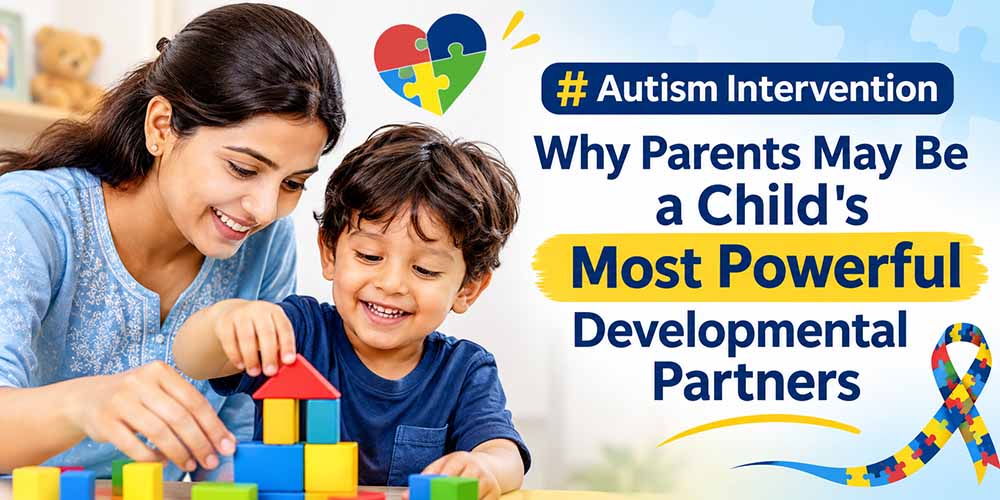
Autism Intervention: Why Parents May Be a Child's Most Powerful Developmental Partners
New Indian research highlights the potential of parent-mediated intervention to improve social functioning and reduce autism symptom severity in young children.
Autism Spectrum Disorder (ASD) is a neurodevelopmental condition that affects social communication, interaction and behaviour. Every child with autism is different, with individual strengths, challenges and developmental needs.
For parents, receiving an autism diagnosis can be overwhelming. Questions about treatment, therapy, communication and the child's future often create considerable anxiety.
One important message, however, deserves greater attention: parents can play an active and powerful role in their child's developmental progress.
Recent Indian research provides encouraging evidence supporting this approach.
Why early intervention matters
The early years of childhood represent an important period of brain development. During this time, children learn through interaction, imitation, play and everyday experiences.
For children with autism, structured developmental support can help improve communication, social engagement, adaptive functioning and learning.
Traditionally, intervention has largely depended on therapist-led sessions. Although professional therapy remains important, access can be limited by cost, availability of trained professionals and geographical barriers.
This raises an important question:
Can parents, when appropriately trained and guided by professionals, become effective partners in delivering developmental intervention at home?
What is parent-mediated intervention?
Parent-mediated intervention involves training parents to use structured developmental strategies during everyday interactions with their children.
Instead of limiting learning to a therapy room, opportunities are created during:
- Playing with toys.
- Sharing meals.
- Reading picture books.
- Talking and singing together.
- Everyday household activities.
- Encouraging eye contact, joint attention and communication.
- Responding positively to a child's attempts to interact.
The objective is to make everyday experiences meaningful opportunities for learning.
Parents receive professional guidance, individualised goals and regular feedback. The intervention is adapted to the child's developmental abilities and the family's circumstances.
What is VQURA?
An innovative Indian approach, VQURA, stands for:
- V – Value-based: Recognising the importance of the child and family.
- Q – Quality interaction: Encouraging meaningful parent–child engagement.
- U – Unique for the child: Individualising intervention according to developmental needs.
- R – Responsive: Understanding and responding to the child's communication and behaviour.
- A – Adapted for family: Making intervention practical within everyday family routines.
The model encourages parents to become active participants in their child's developmental programme, supported by trained professionals.
What does the Indian research show?
A randomized controlled trial published in the Journal of Developmental & Behavioral Pediatrics in 2026 compared VQURA parent-mediated intervention with standard therapist-based intervention.
The study enrolled children aged 24–36 months. Fifty-four children were randomised, and 40 completed the six-month intervention.
The principal findings were encouraging:
- Both groups demonstrated improvements in developmental functioning.
- The parent-mediated group showed a greater reduction in autism symptom severity.
- Improvements in social and adaptive functioning were significantly greater with parent-mediated intervention.
- Motor development also showed a significant between-group advantage.
- Improvements in cognitive and language scores did not demonstrate statistically significant between-group differences.
These findings suggest that structured parental involvement can be a valuable component of early autism intervention.
What does this mean for parents?
The most important message is that developmental support need not stop when a child leaves the therapy centre.
Parents spend substantial time with their children. With appropriate training, they can use daily interactions to encourage communication, social engagement, play and independence.
However, this does not mean that parents must become therapists or replace professional intervention.
Rather, the most useful approach is a partnership between parents, developmental paediatricians, psychologists, special educators and therapists.
A word of caution
The VQURA study is encouraging, but it involved a relatively small sample from a single tertiary-care centre, with six months of follow-up.
Further multicentre research is needed to establish the long-term effectiveness and applicability of this model across different socioeconomic and educational backgrounds.
Every child also requires an individualised intervention plan. No single approach can be expected to work equally well for every child.
The way forward: Empowering parents, supporting children
Autism intervention should extend beyond therapy appointments. It should become part of a child's everyday environment.
Parents need education, practical training, emotional support and regular professional guidance.
Healthcare professionals should encourage families to participate actively in developmental programmes while ensuring access to appropriate specialist services.
The VQURA study adds valuable Indian evidence to the growing interest in family-centred early intervention.
Our message to every parent is simple: Your interaction, patience, responsiveness and encouragement matter. Small moments of meaningful engagement, repeated every day, can create important opportunities for learning and development.
Every child deserves an opportunity to reach their potential.
Early identification. Meaningful intervention. Empowered parents. Better developmental opportunities.